Can I videophone Costa Rica with this service? What equipment to I need to videophone via my PC computer and my daughter's Mac computer?
Low-Cost Appliance Makes Videophoning Accessible To Anyone With A Standard Phone Line
Beamer Videophone
http://www.vialta.com
 = breakthrough technology
Hardware Telephony
Starts at USD $ 149
A newly launched appliance allows anyone to start videophoning anyone else on earth using the same technology while not requiring any type of special telephone technology, Internet connection or service subscription to be utilized.
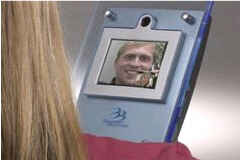
This new technology solution goes under the name of the Beamer Videophone and it is available to the public through a number of US and international distributors at USD $ 249.99.
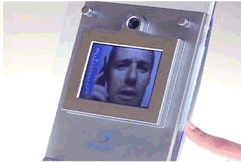
The setup includes a small digital picture frame that stands on any flat surface like a photo holder. The panel connects to your telephone and to the phone wall socket through standard cables.
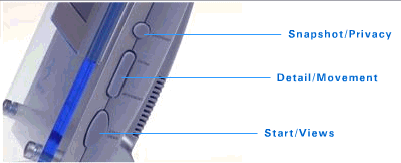
The Beamer has three different viewing choices: you can see yourself, look at the other party or see both simultaneously.
Beamer is effectively an H.324 compliant device and it can theoretically connect to any other H.324 video device.
A snapshot/privacy option allows you to send a high resolution video image and temporarily halt any new video transmission, until you want it to continue.
The Beamer also supports Caller ID (if you have this with your local phone service provider).
Setup is extremely easy and requires only the cables to be connected for the Beamer to work. To see how an actual setup is to be executed you can actually view this online demo.
As soon as you are able to dial into another telephone user using Beamer you can have a full video conversation.
The cost is the same as for a normal phone call and there is no other technology or service that you need to subscribe to, to get this technology to work. You plug it in and it works.
The technology is small and lightweight and can be taken with you anywhere where there is a phone plug. You are not limited to use it at one location.
You can see a simple but well executed demo overview that showcases all of the features and the setup of Beamer in a few Flash screens (see the three titles/buttons on the left side and click them).
You can also connect a special version of the Beamer, the Beamer TV Videophone, to your TV and see your phone conversations on your large color TV screen.
Another advanced version called Beamer FX allows for the easy display of digital images directly from your digital camera memory card utilizing a nice 6.8" LCD TFT screen. The upper memory card slot is a 4-in-1 card reader able to read the following memory card types: SD, Memory Stick®, SmartMedia®, and MultiMediaCard™. VistaFrame's lower memory card slot reads CompactFlash® cards (Type I only). Consumers can view digital pictures directly from their memory card or from the internal memory "My Album". Up to 8 pictures can be saved to its internal memory.
A nice feature of the Beamer Fx allows it to go into power-saving mode after 60 minutes of non-use and to wake up when the built-in motion sensor detects movement, a memory card is inserted, or a button is pressed.
As I do not have the technology here in front of me I am unable to evaluate the effective video quality of this. From my experience and few hints coming from the marketing materials I safely assume that you will not be getting full motion (24 fps) video but an acceptable, 320*240 video feed at a very few frames per second.
According to the company FAQ:
Similar to when you place a regular phone call, Beamer's video quality depends on a number of variables including the quality of the phone line connection. Changes in the quality of the connection will impact the quality of the video. If you have a normal or good phone line connection, you will see a clear, color motion video of the person you are calling, including details like changes in their facial expression.
Not knowing the technology being used to achieve this and having not seen one at work it is difficult to make some reliable and definite evaluations.
Just to stay on the safe side I would say that having read that inside the Beamer is housed a 33.6 modem that works on a standard analog phone line, you should not expect anything near what some software-based videoconferencing tools are capable of today for very little cost (see SightSpeed, Session, Linktivity, Viditel, Squidcam, and others), though Beamer remains undoubtely unparalleled in terms of ease of setup and interoperability.
For all of the above I definitely consider it something to look after.
[Spotted by Mike Bondi - BriddgeConference.co.za]
Readers' Comments
| 2005-06-22 22:40:01 |
| 2004-09-16 05:00:20 |
Did I hear that the chip you use is a Kodak chip?
| 2004-03-20 09:49:44 |
Yes, it will work most everywhere. You can contact directly Vialta to find out in more detail about international distributors and compatibility issues.
| 2004-03-20 09:36:13 |
will it work fr USA say SFCO to Japan? Do you ship this product to Japan?
| 2004-02-25 04:35:22 |
will this work from united states to the the czech republic in eastern europe if so pleaese reply to e mail thanks william
posted by Robin Good on Wednesday, December 10 2003, updated on Tuesday, May 5 2015

969


